

An Introduction to the Trinity

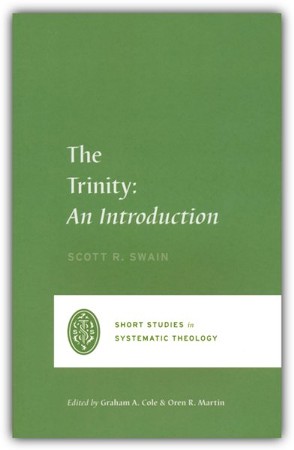
As Christians, we confess that God is the Trinity. We believe that the one God exists in three persons: Father, Son, and Holy Spirit. But what does this really mean? Is this a biblical belief or something that a bunch of dudes made up at a church council? I’ll be honest, whenever I speak or teach about the Trinity I feel like there are pitfalls on every side. There are heresies, errors, and bad analogies everywhere. I recently picked up The Trinity: An Introduction by Scott Swain to help me as I continue to reflect on what it means that the One God exists as the Father, Son, and Holy Spirit. We can always use deeper thinking on the Trinity, and this book provides just that.

In The Trinity: An Introduction, Scott Swain seeks to set forth a biblical view of the Trinity and help us better understand the Bible’s basic “Trinitarian grammar.” Swain shows throughout the book that “Christians praise the triune God because that is how God presents himself to us in Holy Scripture: as one God in three persons, the Father, the Son, and the Holy Spirit,” (20). The theme of praise plays a major role throughout the book. Praise is our response to this doctrine and the goal of studying it. We don’t study the Trinity merely to be able to explain it, but stand in awe of who our Triune God is and embrace his revelation of himself in Scripture (63).

The Trinity is a biblical teaching. It is not something church leaders made up in the fourth century at a church council. The later creeds and confessions don’t improve what’s in the Bible. They are attempts to dig deeply into the Bible’s revelation of God as Triune (26-27). Swain highlights the baptismal formula in Matthew 28:19 as a prime example and summary of the Bible’s “Trinitarian grammar.” Christians are baptized in the one Name of the Father, Son, and Holy Spirit: God is one, and the Father, Son, and Spirit are each identified fully with the one God.

The doctrine of Divine simplicity helps us maintain the unity of God as we confess the Trinity. God is not made up of parts. What he is he is (55). So, the divine persons cannot be parts of God or instances within the category of God (59-60). Yet, while God’s works are indivisible that doesn’t mean his life is incommunicable: “The simple God is the eternal life of communication and communion that is the Father, the Son, and the Holy Spirit, the blessed Trinity,” (62).

Swain notes that “the Bible’s Trinitarian discourse consistently distinguishes the Father, the Son, and the Holy Spirit by their mutual relations, which are ‘relations of origin’” (32). In other words, the distinctions between the three persons of the Trinity are their relations to each other, not to us. These relations are the personal properties of paternity, filiation, and spiration: “the Father eternally begets the Son (paternity), the Son is eternally begotten of the Father (filiation), and the Father and the Son eternally breathe forth the Spirit (spiration),” (68).

Swain spends a chapter on each of these distinctions. He also addresses the three errors of modalism, subordinationism, and eternal relations of authority and submission (ERAS). God’s external works are inseparable, but there remains a general shape to these external works as “God’s external actions proceed from the Father, through the Son, in the Spirit,” (110). Thus, certain external works are appropriated to Father, Son, and Spirit, as they proceed “from the Father through the Son in the Spirit” (111).

The end-goal of the Triune God’s work in the world is himself. He is our supreme good (124). Through the means of grace (the preaching of the Word and the sacraments) the Father calls us to receive the Son by faith through the working of the Spirit in us. We were made to know, love, and praise the one God who is the Father, Son, and Holy Spirit.

Throughout the book, Swain captures historic Christian Trinitarian theology. The book is definitely a more technical and academic read than other books on the Trinity like Michael Reeves’ Delighting in the Trinity, but that is part of the purpose of the book. It belongs to a series of short studies in systematic theology, not a popular-level introduction to the Christian faith.

That being said, Swain emphasizes throughout the book that the reason we study the Trinity is not to dissect the doctrine somehow but to stand in awe before God as we see him revealed in Scripture. Even if a book like this takes more work to read, the work is for end of the praise and worship and love of our God and that is a worthy endeavor.

The book also devotes a whole chapter to divine simplicity, a doctrine that is neglected in many Christian circles and churches today. This neglect leads to problems. We can tend to view God as simply the balance of his attributes or think that one attribute in God somehow dominates another instead of viewing him as the God who is who he is and isn’t made up of parts. He isn’t the sum of his attributes or divided in any way. This is a key doctrine for understanding the unity of the Trinity and the unity in all that God does.

Swain also focuses on the mutual relations of the Father, Son, and Spirit as what distinguishes the persons of the Trinity. The distinctions between the persons are not primarily located in their relationship to us—the Father is not the Father because he is our Father, but because he is the eternal Father of the eternal Son. This distinction is crucial for orthodox (biblical) Trinitarian theology. Distinguishing the persons of the Trinity by their relationship to us quickly leads to errors like modalism (the persons are simply different expressions or modes in which God acts towards us).

Those who are looking to strengthen their understanding of the Trinity and grow in their worship of our Triune God will benefit from reading this book. It’s a short, but meaty book that demands a slow, careful reading. My understanding of the Trinity has been strengthened and, I pray, my worship of God deepened.

Godliness in a Digital Age: Wisdom from a 17th-Century Pastor

Often some of the most relevant wisdom we find (outside the Bible) for living in our digital age comes from old works of timeless truth. I found this to be true as I recently finished reading The Godly Man’s Picture by 17th-century English pastor, Thomas Watson. In the book, Watson seeks to describe what a godly believer looks like and encourages and challenges those who desire to live godly lives in Christ.

In one section near the end of the book, Watson lays out eight ways believers should pursue godliness, answering the question, “What shall we do that we may be godly?” (chapter 7, pp. 223–27 in the Puritan Paperback edition). As I was reading this chapter, I was struck by how relevant Watson’s words are for believers today.

Here are five of Watson’s answers to the question about pursuing godliness, applied to how we can pursue godliness in our digital age:

1. “Accustom yourselves to holy thoughts.”

Watson writes: “If men would step aside a little out of the noise and hurry of business, and spend only half-an-hour every day thinking about their souls and eternity, it would produce a wonderful alteration in them and tend very much to a real and blessed conversion,” (p. 224).

Pursuing godliness will require deep work, “serious meditation” on God’s Word, our own souls, and the eternal age to come. And yet deep work is often what our digital devices war against. Digital technology thrives in the shallows. It promotes distraction and shapes us to value entertainment and quick content consumption.

The problems of distraction and shallow living are not new. People through the ages have tended to busy themselves with anything but serious reflection on our mortality and the eternal age to come. We struggle to spend thirty minutes a day simply thinking deeply about the things of God.

In our digital age, especially, we need to slow down and do the deep work of meditating on God’s Word and things of eternal significance. Our social media feeds promote entertainment and distraction and controversy. We need to break away from that daily, turn on “Do Not Disturb”, and think deeply about the things that really matter. We will struggle in our pursuit of godliness if we are constantly wading in the shallows and neglect to do the deep, hard work of diving into eternal truths everyday.

2. “Watch your hearts.”

Our hearts, according to the prophet Jeremiah, are more deceitful than anything else (Jer 17:9). If we are not watchful, our hearts will lead us into sinful thoughts and actions. But “watchfulness maintains godliness,” (p. 224). The New Testament is filled with the exhortation to believers: Be watchful (e.g., Mark 13:32-37; Luke 21:34-36; 1 Cor 16:13; Heb 2:1; 1 Pet 5:8).

We must watch both our inputs and outputs—what is coming into our hearts and what is coming out. What we take in through our eyes and ears affects our hearts. What we think about and dwell upon can direct our hearts to Jesus or to our sinful desires. At the same time, what spills forth in our words and actions reveals the state of our hearts. “Out of the abundance of the heart the mouth speaks,” (Matt 12:34).

In our digital age, we should be especially alert to the content we view and listen to. We have unprecedented access to an unprecedented amount of inputs. We will never run out of YouTube videos to watch. There will always be new apps to download and podcasts to listen to. We are overloaded with inputs. But if we want to pursue godliness, we must remain watchful and alert to what we our setting our eyes upon and turning our ears to.

We should also ask ourselves: What is spilling out of my heart in how I engage with others online? Why am I posting what I am posting? What we post and how we engage with others online can be a window into our hearts. We must be watchful if we would be godly.

3. “Make spending your time a matter of conscience.”

Wasting time has always been a problem. Watson writes,

“Many people fool away their time, some in idle visits, others in recreations and pleasures which secretly bewitch the heart and take it away from better things. What are our golden hours for but to attend to our souls? Time misspent is not time lived but time lost. Time is a precious commodity.” (p. 224)

It has never been easier to pursue distraction and give in to procrastination. Our digital devices are designed to attract our eyeballs for hours a day. What social platforms, apps, video games, and streaming services want is our attention, and, thus, our time. That’s one reason why a former Netflix CEO once said the greatest enemy to their streaming platform was sleep.

These companies understand that our time is valuable. The question is: do we? Do we actually view our time as a “precious commodity”? Our time is one of the most valuable, limited things we have. What are we using our “golden hours” to pursue? How we spend our time reveals what we really value. So, what does your screen time say about what you value?

Let’s learn this lesson of godliness: we must pay attention to how we use our time. As Paul wrote in Ephesians, “Look carefully then how you walk, not as unwise but as wise, making the best use of the time, because the days are evil,” (Eph 5:15-16).

4. “Make this maxim your own: godliness is the purpose of your creation.”

We were made to live for God and his glory. Our purpose as creation is to bring glory to the Creator. True godliness, at its core, is living for God’s glory in every area of our lives. To be godly is to live for God’s glory in Christ as those filled with the Spirit.

Yet, as Chris Martin puts it in his book The Wolf in Their Pockets, “Our relationship with social media is a powerful factor in distorting our understanding of purpose,” (41). Social media especially puts forth a vision that our purpose is to gain the approval (likes) of others, to post and view content that is valuable according to the world’s standards. Our purpose according to the wisdom of our age is to make our own purpose, and nowhere is that promise held forth more than online where it seems like we can fashion ourselves in anyway we want (Martin, 43).

This maxim must become our own in this digital age: our purpose, the reason why we are here, is to live for the glory of God. We were made for godliness, bringing glory to him and enjoying him forever. We were not made to define our own purpose or to pursue the praise of the crowd. You will not find real purpose and meaning in worldliness or trendiness. You will find your true purpose in godliness. Don’t let our digital age distract you from your true purpose.

5. “Be often among the godly.”

We were made for community. As believers, we need each other. Watson quotes Proverbs 13:20, which says, “Whoever walks with the wise becomes wise, but the companion of fools will suffer harm.” If we want to grow in godliness, we must spend time with those who are farther down the road of godliness than we are.

And this means real, face-to-face community. To be often among the godly means in-person community first and foremost, before online feeds, groups, and forums, etc. Godliness is not something that is really picked up all that well from tweets or YouTube sermon clips. Godliness is learned in community as we do life together and walk together through the ups and downs of life.

Being among the godly, then, means being a part of a true Jesus-exalting, Bible-believing-and-doing church. Livestreams, podcasts, blogs, and Instagram reels are great, but they are nothing compared to the force for godliness that is genuine, gospel-centered community, which should generally be found in the context of the local church. If we wish to be godly, we should seek godly community.

These timeless principles for godliness may seem somewhat basic. But in our digital age, as in all previous generations, we must be intentional about pursuing the end for which we were created: living for the glory of God as we find our joy in him and believe and obey his Word.

What Is Technology? Seeking a Biblical Definition

Technology is all around us. I’m using it to write this. You’re using it to read this. It’s presence is so ubiquitous that we often don’t even think about it. The question, “what is technology?” seems so obvious that we might think that it’s not even worth asking.

Of course we know what technology is! We use it all the time. Our generation has seen incredible technological advances at incredible speeds. Why would we need to ask such a basic question?

Yet, failure to ask such a basic question is part of what lies at the heart of many of our struggles with technology. This kind of attitude leads us to adopt new technologies without giving any thought to potential consequences or the ways technology shapes us.

As Christians who (hopefully!) want to think biblically about technology, we need to ask this question. We need to go back to basics, dive back into Scripture and mine its depths to discern a biblical view of what technology is.

So, what is technology?

1. Technology is an expression of the image of God.

As we read in Genesis 1, God made all things out of nothing by speaking them into existence. God is the Creator. We are creation. Genesis 1:26-28 further teaches us that God created human beings in his image. God made us to show the world what he is like. And part of that is the propensity God wired in us to make stuff.

We image God by taking his creation and becoming sub-creators (to borrow a term from Tolkien) by designing something good from it. The image comes with what is often called the creation mandate: Adam and Eve were called to be fruitful and multiply, subdue the earth and rule and steward it well for God’s glory (Gen 1:28). Human beings have a mandate from God to use the natural resources he has given to make and create things for his glory and the good of others: which means that human beings have a mandate to make technology.

Tim Challies, building on these biblical principles, defines technology as: “the creative activity of using tools to shape God’s creation for practical purposes,” (The Next Story, p. 27). Technology is what happens when image-bearers take the stuff of God’s creation and shape it into something useful. When we make things that promote human flourishing it glorifies God. Technology used well points to the Creator and honors him. This is God’s design for technology, including the digital technology that marks our age.

Yet, when we come to Genesis 3, it all goes wrong. Adam and Eve disobey God. They fail to keep the mandate they have been given, and the curse of sin and death enter the world. So, the next question we have to answer is: how does technology function in light of the fall?

2. Technology is a gift from God to help us endure the effects of the Fall.

Though we are fallen human beings, sinners by nature and rebels against God, we still bear the image of God, even if that image has been distorted by sin. We still have the capacity to make and create. And even if we now use that capacity for sinful purposes, the capacity to make good things remains.

Tony Reinke writes:

God placed this universe, and our own bodies, under a curse so that we would live in hope of the resurrection. By his grace, he also left us with innovative possibilities as a merciful gift to resist some of these effects, to heal some of the creation that is broken, and to give us new ways to manage the pain of life in a fallen universe.

God, Technology, and the Christian Life, p. 133

We can design tools, techniques, and technologies that make farming easier. We develop medicine to treat disease and stave off death. We create communication technologies to alert people of dangerous weather or dangerous situations. We create weapons to defend ourselves from hostile animals and even people. So, even after the Fall, technologies that promote human flourishing are a mercy from God, a gift of his abundant grace to all humanity.

3. Yet, technology is still subject to the Fall.

Nothing in this world is untouched by the curse, including technology. Technology is not morally neutral. All technology can be used for good or evil, and some may even tend toward one or the other.

Technology can be used to hurt and harm others. While God designed our capacity to make tech to be used for his glory and the good of others, we can use technology to dishonor him, feed our sin, and physically and emotionally harm others.

Technology can become an idol we worship and enable other idols. We can look to technology for a kind of deliverance or meaning that only God can provide. Technology, as Challies notes, also enables other idols in our lives (36). Social media feeds the idol of the praise of man. My new iPhone enables the idol of status and image.

Every technology includes elements of risk and danger, as well as benefits (Challies, 41). With the benefits of technology there is a cost, and the most powerful technologies often come with the potential for the greatest cost. With all the benefits communication technologies bring, for example, come dangers and risk related to how we communicate with and view one another.

All technologies fade. None last forever. I may wish that my iPhone or Toyota or refrigerator will last forever. But they won’t. In a few years, my smartphone will be outdated and my car will be scrapped. Human technology, like all material things in this world, fades and decays. Technology too is subject to the Fall.

We see from the first three chapters of Genesis that technology is an expression of the image of God as we make and create things for practical purposes. It is at times a gracious gift from God that helps us endure life in this hard world corrupted by sin. Yet, technology is likewise subject to that same corruption. It is often used for evil, and it will fade.

These points are a crucial starting point for helping us understand technology. They help us avoid the extremes of viewing technology as a purely evil human endeavor or viewing it as the pathway to utopia. These principles help us approach new technologies with both positivity and caution, and they form the foundation for how we live in this digital age as followers of Jesus.