
How do we grow in our walk with God? Plenty of books, articles, podcasts, and sermons try to help us answer that question from various angles. Some claim to offer ancient wisdom, while others suggest practical tips and tricks relevant to our day. Others seem to draw from several Christian traditions (no matter how much they contradict each other) to produce an eclectic approach to spirituality.
One recent book on the subject is Matthew Bingham’s A Heart Aflame for God: A Reformed Approach to Spiritual Formation. Bingham is especially concerned that an eclectic approach to spiritual formation is neither necessary nor useful. He takes us back to an approach rooted in the writings of early modern, Reformed authors.
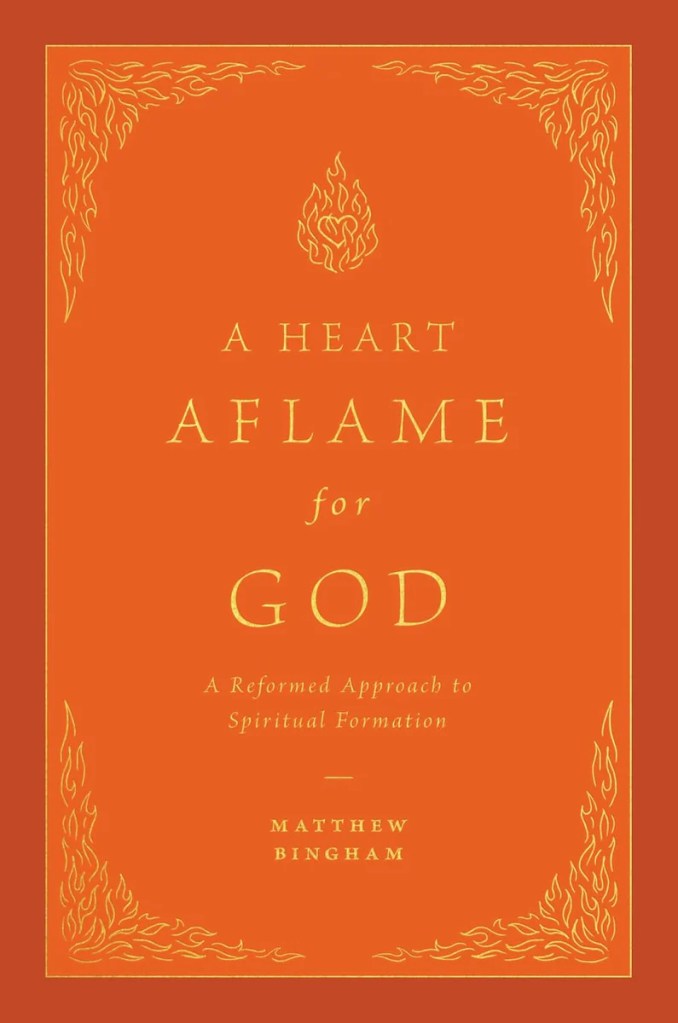
A Heart Aflame for God presents a helpful summary of some of the best thinking on spiritual formation from a biblical perspective. Here are some of the main ideas that I found helpful.
Spiritual Formation and our Reformation Heritage
Throughout A Heart Aflame, Bingham shows that evangelicals have a rich inheritance and deep roots in Reformation Protestantism for spiritual formation (5). We don’t have to follow modern eclectic approaches or feel the need to shift to Roman Catholic or Orthodox traditions to find a richer approach. We already have a very rich, biblical tradition to draw from. Yet many of us have neglected it.
These deeper roots are found in sources like John Calvin and the Reformers, the Puritans, and other early modern Reformed believers (10-12). Bingham explores spiritual formation from their perspective to help believers as they seek to grow in Christ.
Following the Puritans, we can define spiritual formation broadly as keeping the heart (23-27). Spiritual formation is watching what is happening in our hearts in all areas of life. It includes fighting against sin and fighting for a deeper joy in God (24-25).
Bingham defines spiritual formation more specifically as “the conscious process by which we seek to heighten and satisfy our Spirit-given thirst for God (Ps. 42:1-2) through divinely appointed means and with a view toward “work[ing] out [our] own salvation with fear and trembling” (Phil. 2:12) and becoming “mature in Christ” (Col. 1:28),” (35). Spiritual formation is how we seek to grow up in Christ and grow closer to our God.
The Centrality of the Word and the Reformation Triangle
God’s Word is central to our spiritual formation. Bingham writes, “God’s people are most profoundly shaped and formed by God’s word,” (71). This was a major emphasis in early Reformed authors on the subject, and they derived this emphasis from the Bible itself (e.g., Psa 1:1-2; Psa 119:103-04; 2 Tim 3:16-17; Heb 4:12). As B. B. Warfield put it, “Life close to God’s Word is life close to God,” (72).
Bingham also draws from our Reformation heritage to argue that the way to our hearts is primarily through our minds (80). Spiritual growth isn’t the result of practicing the right rituals but is rooted in faithful, Spirit-filled interaction with God’s Word. We should avoid the anti-intellectual spirit all too common today and instead pursue the careful study of and meditation on God’s Word to shape our affections.
Near the end of the book, Bingham also interacts with authors such as James K. A. Smith who criticize a Word-centered approach to spiritual formation in favor of spiritual formation through embodied rituals and liturgies. Bingham agrees with Smith that we want to avoid a “brains-on-a-stick Christianity” (293). Christian spirituality is not merely about having good theology. At the same time, this doesn’t mean that we jettison the centrality of the Word in spiritual formation. There is little biblical or logical reason to accept an argument (like Smith’s) that “the way to the heart is through the body” (301).
Furthermore, Scripture isn’t merely one tool for spiritual formation. All of spiritual formation is connected to Scripture (92). This leads Bingham to present what he calls the “Reformation Triangle” of Scripture reading, meditation, and prayer. These three practices are interrelated and form the foundation of our spiritual formation: “we hear from God through his word, we reflect on what we’ve heard in meditation, and we then respond to God in prayer,” (94).
For many Christians, this may seem obvious. We grow closer to God and more conformed to Christ’s likeness as we read and ponder God’s Word and pray. Yet, we may forget what this represents—communion with God (193). Herman Bavinck explained it eloquently: In Scripture “God daily comes to his people. In it he speaks to his people, not from afar but from nearby,” (91). In prayer, we respond to God and bring our needs before him. Prayer (thoughtful and tethered to biblical truth) is like breathing for believers—natural and life-sustaining (167).
Meditation on Scripture
When it comes to keeping the heart, meditating on God and his truth is also essential. Yet, meditation is often a missing element in our discussions of spiritual formation in the church (139). Meditation takes the Word that we read and seeks to bring it home to our hearts. Drawing from the Puritans, Bingham defines meditation as serious thinking about God’s truth that leads to renewed affections toward God and application of the truth (135-37).
He also draws from the Puritans to present several helpful metaphors for meditation. Meditation is like rekindling a flame from the coals of God’s Word as we seek to warm our hearts (137). It is tasting the sweetness of God’s Word and not only chewing on it but digesting the truth for spiritual nourishment (145-46). Reading God’s Word is like surveying a house from the outside. Meditation is exploring the rooms in the house (154). We find that Scripture is bigger and better than we could have imagined—there is always more to explore.
Meditation is not emptying our minds but filling them with serious thinking about God’s Word that aims for deeper joy in God and more faithful obedience to God. It’s not easy in our fast-paced age that pushes us toward shallow thinking. But it’s essential to a life of flourishing in God’s economy (Psa 1:1-2).
Other Helpful Practices for Spiritual Formation
In the final third of the book, Bingham unpacks several other practices for spiritual formation. These build on the Reformation Triangle rather than being stand alone practices. These include self-examination, reflecting on the natural world, and pursuing godly relationships.
As we meditate Scripture, we bring Scripture to bear on our lives in self-examination. We keep a watch on our hearts and lives by noticing and repenting of sin and finding encouragement in God’s work in our lives (210-12). The natural world also can aid our spiritual formation. Bingham points out how many believers in the past have spent much time in nature, walking the woods in prayer and communion with God (248). God’s creation teaches us God’s truth and helps us savor God’s beauty, even in the ordinary wonders of nature (240, 251-53).
Bingham also makes sure that we don’t reduce spiritual formation to a purely individualistic endeavor. We need godly relationships in the home and the church (258). If we want to grow in maturity, we need godly examples and serious, intentional godly conversation, which the Puritans called “conference” (264-66). We will certainly grow more with the help of godly friends (274).
Finally, Bingham reminds us that we will face many spiritual challenges in our spiritual formation. “Spiritual struggle is a normal part of the Christian life, and no one is exempt,” (307). The reasons for these struggles can include harboring sin (313), our natural temperament (315), worldliness (318), life circumstances (319-20), and the schemes of the devil (321). The major way we face these spiritual struggles is with the means of grace God has given us. There is no magic bullet to overcome these shadowy days in our souls. We simply press on in reading God’s Word, meditating on it, praying to our God, and remaining in godly community.
Final Thoughts
A Heart Aflame for God joins a list of other solid books on pursuing intentional spiritual growth. Other books, like Donald Whitney’s Spiritual Disciplines for the Christian Life, are a little more practical. But A Heart Aflame for God is unique in its intentional focus on wisdom for spiritual formation from early-modern Reformed thinkers and writers.
Bingham focuses on building a foundation for a biblical, Reformed approach to spiritual formation more than presenting a list of disciplines or habits only. This approach also pushes back against other approaches that either promote more mystical practices (not rooted in Scripture) or approach spiritual formation as a buffet of practices we choose from based on what “works” for us.
A Heart Aflame for God reminds us that the simple practices of Scripture reading, meditation, and prayer are the core practices of our personal spiritual formation. When we pursue these for the sake of keeping our hearts, in the context of a community of believers, we will find our walk with God and our affections for God growing and deepening. Other practices might feel more novel and “fresh”, but communion with God in his Word and prayer must remain central in our pursuit of spiritual growth.

 Theology and Technology