
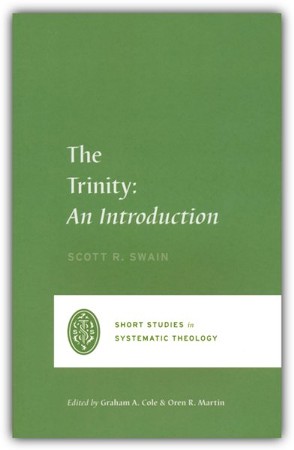
As Christians, we confess that God is the Trinity. We believe that the one God exists in three persons: Father, Son, and Holy Spirit. But what does this really mean? Is this a biblical belief or something that a bunch of dudes made up at a church council? I’ll be honest, whenever I speak or teach about the Trinity I feel like there are pitfalls on every side. There are heresies, errors, and bad analogies everywhere. I recently picked up The Trinity: An Introduction by Scott Swain to help me as I continue to reflect on what it means that the One God exists as the Father, Son, and Holy Spirit. We can always use deeper thinking on the Trinity, and this book provides just that.
In The Trinity: An Introduction, Scott Swain seeks to set forth a biblical view of the Trinity and help us better understand the Bible’s basic “Trinitarian grammar.” Swain shows throughout the book that “Christians praise the triune God because that is how God presents himself to us in Holy Scripture: as one God in three persons, the Father, the Son, and the Holy Spirit,” (20). The theme of praise plays a major role throughout the book. Praise is our response to this doctrine and the goal of studying it. We don’t study the Trinity merely to be able to explain it, but stand in awe of who our Triune God is and embrace his revelation of himself in Scripture (63).
The Trinity is a biblical teaching. It is not something church leaders made up in the fourth century at a church council. The later creeds and confessions don’t improve what’s in the Bible. They are attempts to dig deeply into the Bible’s revelation of God as Triune (26-27). Swain highlights the baptismal formula in Matthew 28:19 as a prime example and summary of the Bible’s “Trinitarian grammar.” Christians are baptized in the one Name of the Father, Son, and Holy Spirit: God is one, and the Father, Son, and Spirit are each identified fully with the one God.
The doctrine of Divine simplicity helps us maintain the unity of God as we confess the Trinity. God is not made up of parts. What he is he is (55). So, the divine persons cannot be parts of God or instances within the category of God (59-60). Yet, while God’s works are indivisible that doesn’t mean his life is incommunicable: “The simple God is the eternal life of communication and communion that is the Father, the Son, and the Holy Spirit, the blessed Trinity,” (62).
Swain notes that “the Bible’s Trinitarian discourse consistently distinguishes the Father, the Son, and the Holy Spirit by their mutual relations, which are ‘relations of origin’” (32). In other words, the distinctions between the three persons of the Trinity are their relations to each other, not to us. These relations are the personal properties of paternity, filiation, and spiration: “the Father eternally begets the Son (paternity), the Son is eternally begotten of the Father (filiation), and the Father and the Son eternally breathe forth the Spirit (spiration),” (68).
Swain spends a chapter on each of these distinctions. He also addresses the three errors of modalism, subordinationism, and eternal relations of authority and submission (ERAS). God’s external works are inseparable, but there remains a general shape to these external works as “God’s external actions proceed from the Father, through the Son, in the Spirit,” (110). Thus, certain external works are appropriated to Father, Son, and Spirit, as they proceed “from the Father through the Son in the Spirit” (111).
The end-goal of the Triune God’s work in the world is himself. He is our supreme good (124). Through the means of grace (the preaching of the Word and the sacraments) the Father calls us to receive the Son by faith through the working of the Spirit in us. We were made to know, love, and praise the one God who is the Father, Son, and Holy Spirit.
Throughout the book, Swain captures historic Christian Trinitarian theology. The book is definitely a more technical and academic read than other books on the Trinity like Michael Reeves’ Delighting in the Trinity, but that is part of the purpose of the book. It belongs to a series of short studies in systematic theology, not a popular-level introduction to the Christian faith.
That being said, Swain emphasizes throughout the book that the reason we study the Trinity is not to dissect the doctrine somehow but to stand in awe before God as we see him revealed in Scripture. Even if a book like this takes more work to read, the work is for end of the praise and worship and love of our God and that is a worthy endeavor.
The book also devotes a whole chapter to divine simplicity, a doctrine that is neglected in many Christian circles and churches today. This neglect leads to problems. We can tend to view God as simply the balance of his attributes or think that one attribute in God somehow dominates another instead of viewing him as the God who is who he is and isn’t made up of parts. He isn’t the sum of his attributes or divided in any way. This is a key doctrine for understanding the unity of the Trinity and the unity in all that God does.
Swain also focuses on the mutual relations of the Father, Son, and Spirit as what distinguishes the persons of the Trinity. The distinctions between the persons are not primarily located in their relationship to us—the Father is not the Father because he is our Father, but because he is the eternal Father of the eternal Son. This distinction is crucial for orthodox (biblical) Trinitarian theology. Distinguishing the persons of the Trinity by their relationship to us quickly leads to errors like modalism (the persons are simply different expressions or modes in which God acts towards us).
Those who are looking to strengthen their understanding of the Trinity and grow in their worship of our Triune God will benefit from reading this book. It’s a short, but meaty book that demands a slow, careful reading. My understanding of the Trinity has been strengthened and, I pray, my worship of God deepened.

 Theology and Technology